- Xplainerr Masterclass
- Posts
- Authentication vs Authorization for APIs - Tech For PM
Authentication vs Authorization for APIs - Tech For PM
Why I am seeing this on a Saturday morning? I wanna sleep :P

Venkatesh Gupta
February 07, 2025
Before diving into authentication and authorization, as I sit here writing this newsletter at 1:19 AM (midnight), I’ve just had a sudden realization—we're already in Feb! The cycle of the year continues (like a fly), and so do our dreams, aspirations, and ambitions.
Okay! Happy Saturday and let’s start with understanding authentication and authorization.
Imagine your house. Before you let anyone in, you check whether the person is allowed to enter. Is it a known person, or perhaps someone who has been referred by a family member? This is authentication—checking the identity of the person before allowing them into your house.
But not everyone who enters your house can go everywhere. A family member may have access to the bedrooms, while a professional guest might only be allowed in the living room and lawn, and a driver may only have access to the lawn. This is called authorization—once someone is allowed into your house, determining what resources they are eligible to access.
I'm usually too lazy to draw diagrams, but here's one I actually attempted using my favorite tool—Miro! (Not a paid sponsorship, but hey, Miro, if you're reading this... 😉)
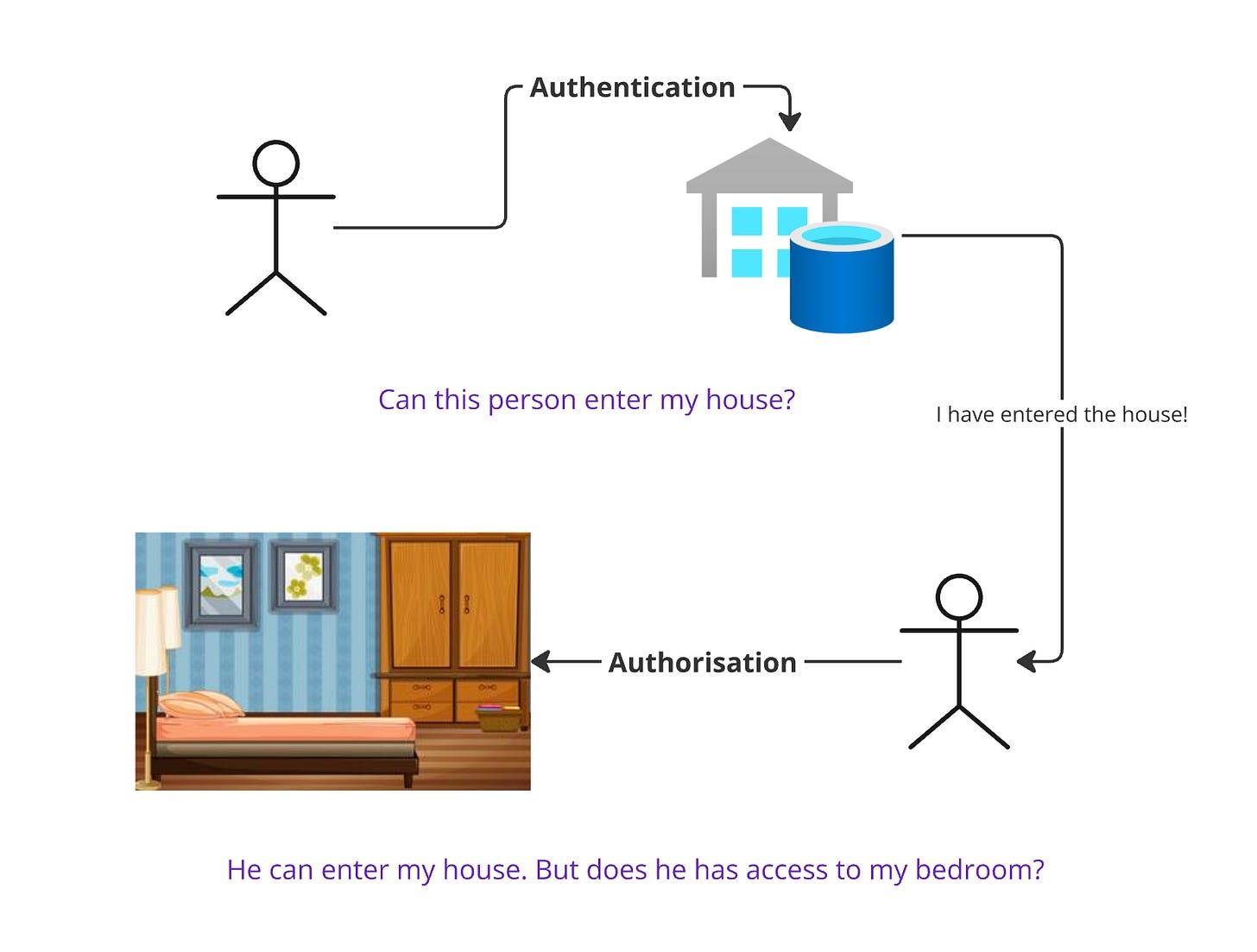
I hope you've got the gist of authentication and authorization in simple terms! But let me dive a little deeper (so you can impress in interviews and sound super smart when chatting with engineers 😎).
Authentication 🔑
Authentication is the process of verifying the identity of a user or system. It's about confirming that the entity trying to access the API is who they claim to be.
Purpose: To ensure that the user or system is genuine.
Process: Typically involves checking credentials, such as:
Username and password
API keys (It’s like a secret key; something like fy34r74y3fyydywvdf6wyfwef)
Tokens (like JWT - JSON Web Tokens)
Example: When you log in to a service with your username and password, the service verifies your credentials to confirm your identity.
Authorization is the process of determining what actions an authenticated user or system is allowed to perform. It controls access to resources and operations.
Purpose: To ensure that the authenticated user or system has the right permissions to access specific resources or perform specific actions.
Process: Typically involves checking permissions or roles assigned to the authenticated user or system against the requested resource or action.
Example: After you log in to a service, you may have different levels of access, such as:
Read-only access to certain data
Write access to update or delete data
Admin access to manage users and settings
By now, you’ve probably realized just how simple authentication and authorization really are. (But shhh… don’t tell your engineers!). Let me quickly sum up the difference again for an easy reference but before that ……
Do you truly understand technology as a Product Manager? Or do you find yourself under confident when defining tech requirements? Or feel lost in engineering meetings?
Knowledge of tech as a PM accelerates your career trajectory, boosts your paycheck by 35%, and helps you transition into leadership roles faster. I run a 3-week online course, Tech for Product Managers, attended by PMs from Uber, Amazon, Razorpay, CRED, and more.
As a special offer for my newsletter community, I’m offering 40% off on the course!
Check it out here:
👉 Tech for Product Managers
Tada! 💌
Authentication: "Who are you?"
Authorization: "What are you allowed to do?"
In the context of APIs, you might authenticate with an API key or OAuth token, and then the API will check what resources and actions you are authorized to access based on your identity and permissions.